
The Most Detailed Classification and Application Summary of Adhesives
There exists a wide variety of adhesives, which can be categorized by chemical composition, intended use and physical form. This article sorts out the classification and applications of adhesives from these three dimensions for your reference.
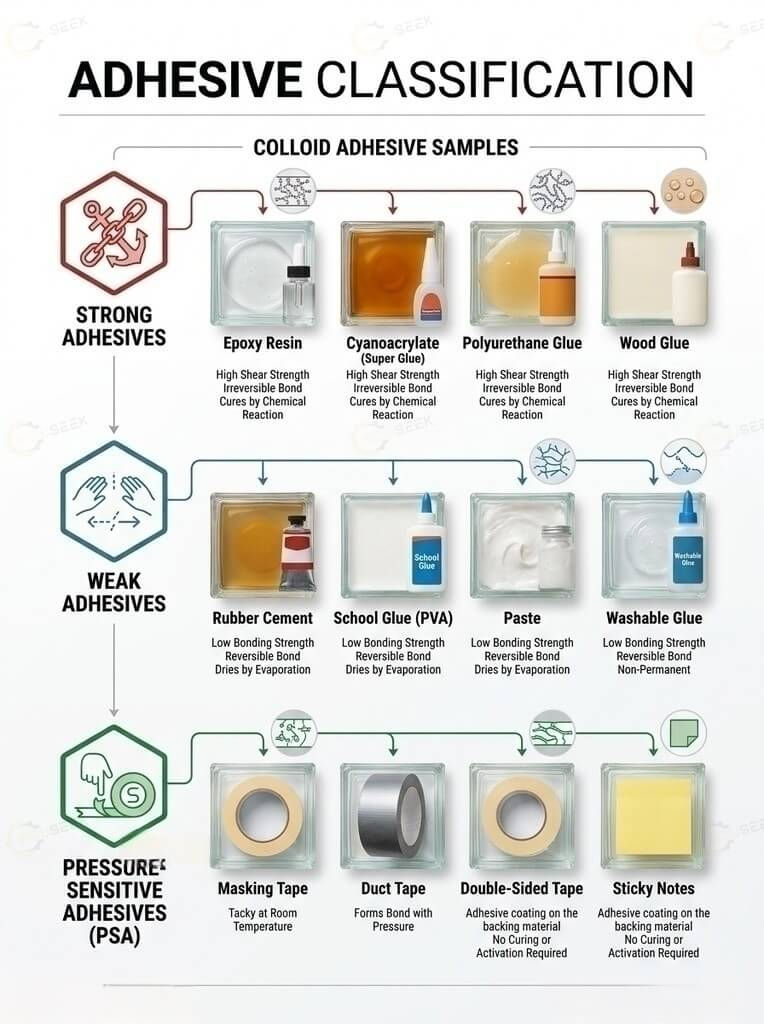
I. Classification by Chemical Composition
Common adhesive varieties include urea-formaldehyde resin adhesives, polyvinyl acetate adhesives, polyacrylate resin adhesives, polyurethane adhesives, hot-melt adhesives, epoxy resin adhesives and synthetic adhesives, among others.
1. Silicone Adhesives
A type of sealant featuring cold resistance, heat resistance, anti-aging performance, waterproof and moistureproof properties, high resistance to expansion-contraction fatigue, low permanent deformation and non-toxicity. Silicone adhesives have undergone rapid domestic development in recent years, yet part of their raw materials still rely on imports in China.
2. Polyurethane Adhesives
Capable of bonding diverse materials while retaining the physical and chemical properties of bonded substrates even at low or ultra-low temperatures. They are widely applied in shoemaking, packaging, automotive manufacturing, magnetic recording materials and other industries.
3. Polyacrylate Resin Adhesives
Primarily used for manufacturing pressure-sensitive adhesives, with additional applications in textile and construction sectors.
Construction adhesives: For decoration, sealing and structural bonding in construction projects.
4. Hot-Melt Adhesives
Classified by raw materials into EVA hot-melt adhesives, polyamide hot-melt adhesives, polyester hot-melt adhesives, polyolefin hot-melt adhesives, etc. EVA hot-melt adhesives dominate domestic production and consumption at present. Polyolefin adhesives are mainly made from ethylene copolymers, SBS and SIS block copolymers.
5. Epoxy Resin Adhesives
Suitable for bonding metals with most non-metallic materials, extensively used in construction, automobile, electronics, electrical appliances and daily consumer goods.
6. Urea-Formaldehyde, Phenolic & Melamine-Formaldehyde Adhesives
Mainly adopted by the wood processing industry, yet their formaldehyde emission after application exceeds international standards.
Woodworking adhesives: Used for medium-density fiberboards, gypsum boards, plywood, particle boards and similar timber products.
7. Synthetic Adhesives
Applied across wood processing, construction, decoration, automotive, shoemaking, packaging, textile, electronics, printing and bookbinding industries.
China imports nearly 200,000 tons of synthetic adhesives annually, covering hot-melt adhesives, silicone sealants, polyacrylate adhesives, polyurethane adhesives, PVC plastic adhesives for automobiles and more. Meanwhile, around 20,000 tons of synthetic adhesives are exported each year, mainly polyvinyl acetate, polyvinyl formal and pressure-sensitive adhesives.
II. Classification by Intended Use
1. Sealants
For joints of doors, windows and prefabricated components of assembled buildings. High-end sealants are silicone and polyurethane sealants; mid-range options include neoprene adhesives and polyacrylate sealants.
In China’s construction adhesive market, silicone and polyurethane sealants represent the mainstream development trend, accounting for approximately 30% of construction sealant sales volume currently.
2. Structural Construction Adhesives
For connecting structural components, such as external repair of reinforced concrete structures, metal reinforcement and on-site building construction. Epoxy resin series adhesives are generally preferred for such scenarios.
3. Automotive Adhesives
Divided into four categories: body adhesives, interior decoration adhesives, windshield glass adhesives and chassis adhesives.
China’s annual consumption of automotive adhesives stands at roughly 40,000 tons, among which PVC plastic adhesives, neoprene adhesives and asphalt-based adhesives have the largest consumption volume.
4. Packaging Adhesives
Mainly used to manufacture pressure-sensitive tapes and labels, bonding paper, plastic, metal and other packaging substrates.
Paper packaging: Polyvinyl acetate emulsion adhesives
Plastic & metal packaging: Polyacrylate emulsion, VAE emulsion, polyurethane adhesives and cyanoacrylate adhesives
5. Electronic Adhesives
Low annual consumption (less than 10,000 tons), mostly for integrated circuits and electronic components. The mainstream varieties are epoxy resin, unsaturated polyester resin and silicone adhesives.
China can independently supply end-sealing adhesives for 5-micron electronic components, while adhesives for 3-micron components still depend on foreign imports.
6. Shoemaking Adhesives
Annual consumption totals about 125,000 tons, including 110,000 tons of neoprene adhesives and 15,000 tons of polyurethane adhesives.
Neoprene adhesives adopt benzene-based solvents which are harmful to human health and should be restricted. Polyurethane adhesives will become the mainstream choice to meet the development demands of the shoemaking industry.
III. Classification by Physical Form
1. Sealants
1.1 Classification by Curing Mechanism
(1) Moisture-Curing Sealants
Cure via moisture in ambient air, mainly single-component polyurethane, silicone rubber and polysulfide rubber sealants. Their polymer base contains active functional groups that react with atmospheric water to form cross-linked networks and solidify the sealant.
(2) Chemical-Curing Sealants
Two-component polyurethane, silicone rubber, polysulfide rubber, neoprene and epoxy sealants fall into this category, which mostly cure at room temperature. Certain single-component chlorosulfonated polyethylene, neoprene sealants and PVC paste sealants require heating to complete curing via chemical reactions.
(3) Thermoplastic Sealants
Two distinct thermoplastic systems: PVC resin dispersed with plasticizers, and rubber-asphalt blended sealants. Vinyl resin plasticizers exist as liquid suspensions at room temperature and harden into solids upon heating; rubber-asphalt blends function as hot-melt sealants.
(4) Oxidation-Curing Sealants
Joint caulks and glazing sealants with dry or semi-dry vegetable/animal oil as base materials, including refined polymerized, blown and chemically modified oils.
(5) Solvent-Vaporization Sealants
Based on non-tacky polymers left after solvent evaporation, including butyl rubber, high-molecular-weight polyisobutene, polyacrylates of specific polymerization degrees, chlorosulfonated polyethylene and neoprene sealants.
1.2 Classification by Physical State
(1) Putty-Like Sealants
Primarily for static joints with a service life of 2 years or longer, formulated from three core raw materials: oil-resin blends, polybutene and asphalt.
(2) Liquid Elastomeric Sealants
Liquid polymers that cure into true elastic materials capable of enduring repeated joint deformation. Base elastomers include liquid polysulfide rubber, mercapto-terminated polyethers, liquid polyurethane, room-temperature-vulcanized silicone rubber and low-molecular-weight butyl rubber. These sealants are usually two-part systems mixed prior to application.
(3) Hot-Melt Sealants (Hot-Applied Sealants)
Formulated with blends of elastomers and thermoplastic resins. Extruded directly into joints at 150–200°C through specialized nozzles. Thermal application improves substrate wetting and adhesion to most materials; the sealant cools rapidly to form a rigid, low-shrink elastic film.
Main raw materials: polyisobutene polymers, EPDM and thermoplastic styrenic block copolymers, blended with thermoplastics such as EVA, EEA, polyethylene, polyamide and polyester.
(4) Liquid Gasket Sealants
Replace solid gaskets for sealing mechanical mating surfaces and prevent internal fluid leakage. Formulated with polymer substrates (rubber, resin) plus fillers and auxiliary additives, divided into four types by property: non-drying tacky, semi-drying viscoelastic, dry adherent and dry peelable, selected according to application scenarios and requirements.
1.3 Classification by Post-Curing Performance
(1) Curable Sealants
a) Rigid sealants: Form hard solids with minimal elasticity after curing; many provide both sealing and bonding effects. Representative types are based on epoxy, polyester, polyacrylate, polyamide and polyvinyl acetate resins.
b) Flexible sealants: Retain softness post-curing, formulated with rubber elastomers as base materials. Hardness ranges widely from Shore A 10 to 80; some varieties are pure rubber with excellent adhesive performance.
(2) Non-Curable Sealants
Soft plastic sealants that remain permanently tacky after application, generally paste-like and applicable with scrapers or brushes. Customizable to various viscosities and functional properties.

2. Classification by Curing Method (Code Markers)
a: Low-temperature curing
b: Room-temperature curing
c: Heat curing
d: Multi-temperature compatible curing
e: Water-triggered curing
f: Anaerobic curing
g: Radiation curing (UV, electron beam, radioactive ray)
h: Hot-melt & cold-set curing
i: Pressure-sensitive adhesion
j: Coagulation/flocculation curing
k: Other curing types
3. Classification by Bonded Substrate (Code Markers)
A: Multiple composite materials
B: Wood
C: Paper
D: Natural fibers
E: Synthetic fibers
F: Polyolefin fibers (excluding Category E)
G: Metals & alloys
H: Hard-to-bond metals (gold, silver, copper, etc.)
I: Metallic fibers
J: Inorganic fibers
K: Transparent inorganic materials (glass, gemstones, etc.)
L: Opaque inorganic materials
M: Natural rubber
N: Synthetic rubber
O: Hard-to-bond rubber (silicone rubber, fluororubber, butyl rubber)
P: Rigid plastics
Q: Plastic films
R: Leather & artificial leather
S: Foamed plastics
T: Hard-to-bond plastics & films (fluoroplastics, PE, PP, etc.)
U: Biological tissues, bones & dental materials
V: Other substrates
4. Adhesive Physical Form (Code Markers)
1: Solvent-free liquid
2: Organic solvent-based liquid
3: Water-based liquid
4: Paste/putty
5: Powder, granule, block
6: Sheet, film, mesh, tape
7: Filament, strip, rod

5. Other Special Adhesive Categories (Low-Frequency Usage)
Structural Adhesives
Metal structural adhesives, polymer structural adhesives, photosensitive sealing structural adhesives, other composite structural adhesives
Thermosetting Polymer Adhesives
Epoxy adhesives, PU adhesives, amino resin adhesives, phenolic resin adhesives, acrylic resin adhesives, furan resin adhesives, resorcinol-formaldehyde resin adhesives, xylene-formaldehyde resin adhesives, unsaturated polyester adhesives, composite resin adhesives, polyimide adhesives, urea-formaldehyde resin adhesives, other polymer adhesives
Sealants
Room-temperature vulcanized silicone rubber, epoxy sealants, polyurethane sealants, unsaturated polyester sealants, polyacrylate sealants, sealing putty, neoprene sealants, elastomeric sealants, liquid gasketing materials, polysulfide rubber sealants, other sealants
Hot-Melt Adhesives
Hot-melt sticks, pellets, powder, EVA hot-melt adhesives, rubber hot-melt adhesives, PP, polyester, polyamide, PU hot-melt adhesives, styrenic hot-melt adhesives, new-generation hot-melt adhesives, PE & ethylene copolymer hot-melt adhesives, other hot-melt adhesives
Water-Based Adhesives
Acrylic emulsions, vinyl acetate emulsions, polyvinyl butyral adhesives, emulsion adhesives, other water-based adhesives
Pressure-Sensitive Adhesives (Self-Adhesives)
Liquid PSA, adhesive tapes, solvent-free PSA, solvent-based PSA, curable PSA, rubber-based PSA, acrylic PSA, other pressure-sensitive adhesives
Solvent-Borne Adhesives
Resin solution adhesives, rubber solution adhesives, other solvent-based adhesives
Inorganic Adhesives
Hot-melt inorganic adhesives, air-dry inorganic adhesives, chemical-reaction inorganic adhesives, hydraulic inorganic adhesives, other inorganic adhesives
Thermoplastic Polymer Adhesives
Solid polymer adhesives, solution polymer adhesives, emulsion polymer adhesives, monomer polymer adhesives, other thermoplastic polymer adhesives
Natural Adhesives
Protein adhesives, carbohydrate adhesives, other natural adhesives
Rubber-Based Adhesives
Silicone rubber adhesives, neoprene adhesives, nitrile rubber adhesives, modified natural rubber adhesives, chlorosulfonated polyethylene adhesives, polysulfide rubber adhesives, carboxylated rubber adhesives, polyisobutene & butyl rubber adhesives, other rubber adhesives
High-Temperature Resistant Adhesives
Silicone adhesives, inorganic adhesives, high-temperature mold resin adhesives, metal high-temperature adhesives, other heat-resistant adhesives
Polymer Adhesives
Nitrile polymer adhesives, polysulfide rubber adhesives, PVC adhesives, polybutadiene adhesives, perchlorovinyl adhesives, other polymer adhesives
Repair Compounds
Metal repair agents, high-temperature repair agents, emergency repair agents, wear-resistant repair agents, anti-corrosion repair agents, plastic repair agents, other repair compounds
Special Functional Adhesives
Medical adhesives, paper adhesives, magnetic conductive adhesives, magnetic shielding adhesives, fire-resistant adhesives, quenching prevention adhesives, quenching crack resistant adhesives, animal glues, vegetable glues, mineral adhesives, food-grade adhesives, other specialty adhesives


Comments